
July 28, 2026
Data Notifications: Where Commercial and Technical Ops Meet
commercial management,
Get notified of the latest news, insights, and upcoming industry events.
Reducing Risk Through Better Data Notification Management

Data Notifications are a growing operational challenge for market data teams. While they are often viewed as an administrative process, they can have significant commercial, licensing, governance, and technical consequences. As notification volumes continue to grow, firms are increasingly looking for ways to automate analysis, improve governance, and reduce the risk of missed changes. This article explores why Data Notifications sit at the intersection of commercial management and technology operations, and how organisations can manage them more effectively at scale.
This Article Covers:
DOWNLOAD AS PDF
Data Notifications Are Becoming Harder to Manage
 Every financial institution relies on market data from exchanges and vendors such as Bloomberg, LSEG, and numerous specialist providers. Alongside the data itself comes a constant stream of Data Notifications. These notifications communicate pricing updates, licensing changes, entitlement amendments, policy updates, product launches, migrations, and service retirements.
At first glance, data notifications appear to be administrative communications, but every single notification may affect users, applications, permissions, costs, and operational workflows.
As market data estates continue to expand, the volume and complexity of Data Notifications are increasing. Market data teams must process more notifications, analyse more data, and coordinate more stakeholders than ever before. Yet many organisations still rely on manual processes involving emails, spreadsheets, vendor portals, usage reports, and ticketing platforms to manage notifications.
The challenge is no longer simply keeping up with notifications. It is ensuring that every change is understood, assessed, approved, and implemented before it affects the business.
What Happens When a Notification Is Missed?
Data Notifications are one of the few areas where commercial administration and technology operations share responsibility.
Commercial teams are responsible for vendor relationships, licensing, entitlements, permissions, governance, and market data spend. On the other hand, technology teams manage the platforms, infrastructure, applications, and services that deliver market data to the business.
Most of the time, Commercial and Technology teams’ responsibilities are defined and separated. Data Notifications change that.
Consider an entitlement platform like DACS from LSEG. Technology teams maintain the platform, understand its dependencies, and operational requirements. Commercial teams manage the exchanges, permissions, users, and licensing arrangements that sit within it.
When a vendor issues a pricing change, entitlement update, migration notice, or product retirement, both teams must respond to the same event from different perspectives. Both teams must review vendor documentation, identify affected services, analyse usage reports, determine commercial impacts, engage stakeholders, raise tickets, and track actions to completion.
The risk is that these processes are often highly manual and possibly missed. As notification volumes grow, so does the potential for human error.
Missed Data Notification may lead to:
- Unexpected cost increases.
- Licensing discrepancies.
- Delayed entitlement updates.
- Compliance concerns.
- Service configuration issues.
- Missing market data.
- Application disruption.
- Increased operational risk.
What begins as an administrative oversight can quickly escalate into a production incident.
Market data may no longer reach traders, applications, or downstream systems. Technical teams are then pulled into incident resolution, while commercial teams are required to investigate the root cause and manage vendor communications. The result is a process that consumes significant operational effort across both functions.
As market data environments become more complex, the existing approach becomes increasingly difficult to sustain.

"The Exchange Data Notification tool has transformed how we assess the impact of exchange changes. Rather than manually reviewing notices and tracing dependencies, we can now immediately identify affected clients and services, significantly reducing both effort and operational risk.” - Jack Woodford, Project Team Lead at CJC Ltd. |
DN Hub: Automating Data Notification
At CJC, this challenge became increasingly visible while our teams supported some of the world's largest financial institutions. Across the industry, three consistent trends emerged:
- Increasing Data Notification volumes.
- Growing entitlement complexity.
- Rising operational effort associated with manual analysis.
Although existing governance processes remained effective, the long-term trajectory was clearly unsustainable.
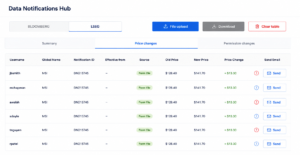
Illustration A: Track pricing changes, identify affected users, and assess cost impacts.
This shared challenge between our technical and commercial teams led to the development of Data Notifications Hub (DN Hub), a platform designed to automate the capture, analysis, validation, and operational management of Data Notifications. It automatically compares exchange and vendor notifications against client usage and permissioning data, helping organisations quickly identify:
- Affected users.
- Affected applications.
- Permissioning changes.
- Pricing impacts.
- Licensing implications.
- Product and service changes.
The DN Hub platform also provides workflow management, reporting, auditability, risk classification, and operational visibility across the notification lifecycle . Rather than relying on manual reconciliation across multiple systems, teams can manage notification workflows through a structured and scalable operational process.
|
Real-World Validation The benefits of automation become particularly clear when compared with traditional manual processes. During internal validation testing, CJC compared DN Hub against an existing manual review process for a quarterly exchange notification. According to Jack Woodford, Project Team Lead at CJC, “DN Hub provided an exact match to my manual effort. The main difference being it took me 2 minutes in the DN Hub, compared to an hour and a half of manual work.” The automated workflow produced the same result while significantly reducing the time required to complete the analysis. |

Key Takeaways
- Data Notifications affect both commercial management and technology operations.
- Manual notification management becomes harder as market data estates grow.
- Missed notifications can create commercial, licensing, and operational risks.
- Data Notifications are one of the few market data processes shared by both commercial and technical teams.
- Automation can help improve governance, visibility, efficiency, and operational resilience.
Looking Ahead
Data Notifications will continue to be one of the most important intersections between commercial management and technology operations. As market data environments grow in complexity, organisations will face increasing pressure to improve governance, reduce manual effort, and minimise operational risk.
The firms that respond successfully will be those that treat Data Notifications not as a standalone administrative task, but as a critical operational process that spans commercial, technical, licensing, and governance functions.
Automation provides an opportunity to reduce effort, improve visibility, strengthen controls, and help ensure that important changes are identified and actioned before they become operational issues.
About CJC
CJC is the leading market data technology consultancy and service provider for global financial markets. CJC provides multi-award-winning consultancy, managed services, cloud solutions, alert monitoring and observability, and commercial management services for mission-critical market data systems. CJC is vendor-neutral and ISO 27001 certified, enabling CJC’s partners the freedom to focus on their core business.
For More Information:
Email: marketing@cjcit.com
Tel: +44(0) 203 328 7600
Get In Touch
Get in touch with our experts to learn how we can help you optimise
your market data ecosystem!
Arrange a Meeting